Showing posts with label Islamic. Show all posts

Islamic Worship

What is Islam? (part 4 of 4): Islamic Worship

1) The ‘Declaration of Faith

A Muslim is one who testifies that “none deserves worship but Allah, and Muhammad is the messenger of Allah.” This declaration is known as the “shahada” (witness, testimony). Allah is the Arabic name for God, just as Yahweh is the Hebrew name for God. By making this simple proclamation one becomes a Muslim. The proclamation affirms Islam’s absolute belief in the oneness of God, His exclusive right to be worshipped, as well as the doctrine that associating anything else with God is the one unforgivable sin as we read in the Koran:

“God does not forgive anyone for associating something with Him, while He does forgive whomever He wishes to for anything else. Anyone who gives God partners has invented an awful sin.” (Quran 4:48)

The second part of the testimony of faith states that Muhammad, may the mercy and blessings of God be upon him, is a prophet of God like Abraham, Moses and Jesus before him. Muhammad brought the last and final revelation. In accepting Muhammad as the “seal of the prophets,” Muslims believe that his prophecy confirms and fulfills all of the revealed messages, beginning with Adam’s. In addition, Muhammad serves as the role model through his exemplary life. A believer’s effort to follow Muhammad’s example reflects the emphasis of Islam on practice and action.

2) The Prayer (Salah)

Muslims worship five times a day: at daybreak, noon, mid afternoon, sunset, and evening. It helps keep believers mindful of God in the stress of work and family. It resets the spiritual focus, reaffirms total dependence on God, and puts worldly concerns within the perspective of the last judgment and the afterlife. The prayers consist of standing, bowing, kneeling, putting the forehead on the ground, and sitting. The Prayer is a means in which a relationship between God and His creation is maintained. It includes recitations from the Quran, praises of God, prayers for forgiveness and other various supplications. The prayer is an expression of submission, humility, and adoration of God. Prayers can be offered in any clean place, alone or together, in a mosque or at home, at work or on the road, indoors or out. It is preferable to pray with others as one body united in the worship of God, demonstrating discipline, brotherhood, equality, and solidarity. As they pray, Muslims face Mecca, the holy city centered around the Kaaba - the house of God built by Abraham and his son Ishmael.

3) The Compulsory Charity (Zakah)

In Islam, the true owner of everything is God, not man. People are given wealth as a trust from God. Zakah is worship and thanksgiving to God by supporting the poor, and through it one’s wealth is purified.. It requires an annual contribution of 2.5 percent of an individual’s wealth and assets. Therefore, Zakah is not mere “charity”, it is an obligation on those who have received their wealth from God to meet the needs of less fortunate members of the community. Zakah is used to support the poor and the needy, help those in debt, and, in olden times, to free slaves.

4) The Fast of Ramadan (Sawm)

Ramadan is the ninth month of the Islamic lunar calendar which is spent in fasting. Healthy Muslims abstain from dawn to sunset from food, drink, and sexual activity. Fasting develops spirituality, dependence upon God, and brings identification with the less fortunate. A special evening prayer is also held mosques in which recitations of the Quran are heard. Families rise before dawn to take their first meal of the day to sustain them till sunset. The month of Ramadan ends with one of the two major Islamic celebrations, the Feast of the Breaking of the Fast, called Eid al-Fitr, which is marked by joyfulness, family visits, and exchanging of gifts.

5) The fifth Pillar is the Pilgrimage or Hajj to Mecca..

At least once in a lifetime, every adult Muslim who is physically and financially able is required to sacrifice time, wealth, status, and ordinary comforts of life to make the Hajj pilgrimage, putting himself totally at God’s service. Every year over two million believers from a diversity of cultures and languages travel from all over the world to the sacred city of Mecca[1] to respond to God’s call.

Who are Muslims?.

The Arabic word “Muslim” literally means “someone who is in a state of Islam (submission to the will and law of God)”. The message of Islam is meant for the entire world, and anyone who accepts this message becomes a Muslim. There a over a billion Muslims worldwide. Muslims represent the majority population in fifty-six countries. Many people are surprised to know that the majority of Muslims are not Arab. Even though most Arabs are Muslims, there are Arabs who are Christians, Jews and atheists. Only 20 percent the world’s 1.2 billion Muslims come from Arab countries. There are significant Muslim populations in India, China, Central Asian Republics, Russia, Europe, and America. If one just takes a look at the various peoples who live in the Muslim World - from Nigeria to Bosnia and from Morocco to Indonesia - it is easy enough to see that Muslims come from all different races, ethnic groups, cultures and nationalities. Islam has always been a universal message for all people. Islam is the second largest religion in the world and will soon be the second largest religion in America. Yet, few people know what Islam is.

The Law is Islamic by Nature:

The Law is Islamic by Nature:

If this dualism were to be destroyed, law would disappear. In the first case, law reduces itself to its subject – that is, interest, power, politics, to the utilitas of Roman law; in the second case, it sublimates itself to an abstract idea of righteousness or to moral appeal. In both cases, it ceases to be law.

Accordingly, law cannot be based on one principle only. Neither Christianity nor materialism can produce a system of law. Law, as seen by Christians, is an illusory attempt at bringing this world into order, an attempt inevitably bound to fail in the end. Jesus came to restore love and not the justice of the Old Testament. Nevertheless, love does not belong to this world; it is heavenly virtue.[1] Jesus did not recognize the need for judges,[2] while Hugo Grotius cuts the former connection between natural law and the “Sermon of the Mount” because of “its higher degree of holiness.”

Law is objective, involved in politics and society, totally facing this world. But at the same time, it includes norms and ethics and tries to bring into this world the principle of justice – that is, a moral principle, which means something being not “of this world.” As such, law is a “bipolar unity” – like man and Islam.

Law cannot be established only by religion or materialism, nor can it be established contrary to them. Without Christian emphasis on the value of man’s personality – his intention, righteousness, natural human rights, and so forth – there is no law. On the other hand, without admitting the value and importance of this world and without interests and power – without that which Judaism emphasized – law will have no meaning. Without the Christian approach, it would not be possible and without the Jewish approach, it would not be necessary. From the said premises, it follows that law is Islamic by nature.

Historically speaking, law is a phenomenon of the mature stage in the life of a culture. It emerges in the time of balance between religious and people’s socio-political aspirations. This is a time when religious feelings are still strong and are capable of influencing the people’s life, but are already limited to a great extent by the rational utilitarian reasons of the coming civilization. Besides man, whose value was confirmed and established by religion, society also emerges as an independent reality. At that moment, they are two equal values. Their balance (Islamic balance) is a prerequisite to creating and developing a complete system of the law.

The situation can be observed in the emergence of the three most famous law systems in history: the Roman, the Islamic, and the European. The first phase of Roman law, known as the time of the civil law (period of the Kingdom and the first three centuries of the Republic), is characterized by a complete identity between law and religion, between ius and fas. Civil rule (ius) has the nature of the religious norm (fas), and vice versa. Later, these principles are separated from each other. Nevertheless, Roman civilization and Roman political thinking had to be permeated by stoical moral and religious philosophy in order to enable the further development of its law. The Roman empiric principle of utilitas joined the stoical idealistic idea of lex universalis[3] for neither Roman civilization nor the Stoical philosophy could create the Roman legal system by itself. [4]

In Islam, we find a kind of “personal unity” between law and theology. Almost every great “religious” thinker of Islam has written books on jurisprudence.[5] It is difficult for Europeans to distinguish between law and theology in these works. Islam does not recognize this separation. In a sense, law is a natural product of Islam. Alfred V. Karmer writes: “The Arabs [Muslims] are the only people during the early Middle ages who, in developing the science of law, “achieved significant results. These results, in their grandiosity, stand immediately with the works of the Romans, the lawmakers of the world.”

In European history, the development of law starts along with the overcoming of the Church and continues up to the appearance of socialist theories and socialism in European Science. These few centuries, when elements of European culture and European civilization coexist, is the period of great European charters and codes. This dualism – in essence Islamic dualism – is reflected very clearly in the great juridical opus of Hugo Grotius, the central personality of European juridical thinking. At the end of the Reformation, he summed up the teachings of Catholic and Protestant juridical writers, and proved how law is, at the same time, dependent upon and independent from ethics and religion. Later, because of this dualism, some writers (such as Werner and Ahrens) tried to prove that the distinction made between law and morality was a great achievement of Grotius, while the others (such as Kirchmann) tried to prove the opposite. With the claim that God is the ultimate source of law, Grotius confirmed his belief in the mutual relation between law and religion.

The independence of law cannot be destroyed even in the most politically extreme Marxist state. Regardless of very clear theoretical views, in practice it is not possible to completely identify law with the will of the state – there always remains an insurmountable distance. Socialism and an independent developed, and free juridical system are mutually exclusive.[6] Every law needs distance and standards. Socialism requires immediateness, objectiveness, and direct action. In socialism, which applies physical (or biological) habits of thinking to social life, there is no room for law since law is the opposite of physics, not recognizing “should” by only “is.”[7]

The poor reputation of courts in people’s democracies is the result of the ideological attitude toward law which, in spite of all pressures, remains in a sense natural law and not the will of the ruling class. Courts, as the executors of law, must share the bad position of law in general and be in “disfavor” (this is also true with the legal profession). Every government of this type tries to degrade law to the rank of politics, and courts to the rank of secretariats; but, as it never completely succeeds in this, it usually ignores the courts and, when necessary, uses direct prosecution by the police, the administrative authorities, and concentration camps – that is, the extra-judicial means. The state and the government are the expression of physical power, the courts and law of moral power. To recognize that the moral power of the courts and law can balance the physical power of the state means to recognize the supremacy of an idea over things and mind over matter. The principle of court independence is not compatible with the system of an atheistic state.[8]
The consistent part of the said situation is the disrespect of their own laws, and the “production’ of an inflationary number of regulations.[9] Such is the consequence of ‘direct action” – that is, the attempt to replace law by political action, or simply by political regulations, letters, messages, and even speeches of leaders which become more important that the constitution and laws, for example, the Quotations of Chairman Mao. In all states of this type, we meet the large power of the executive authorities at the expense of the elected bodies and the police at the expense of the courts and the legal profession. These kinds of states are trying to make courts obedient tools in the hands of the administrative authorities, but they are never completely successful. Law can be curbed or subdued to some extent but, like man, it cannot be destroyed or reduced to nothing.

All men believe in the soul and act accordingly, even if they do not away speak up. If somebody has committed a murder and admits it, but insists that he did it unintentionally, what follows then with the prosecutor, the defense, the witnesses, the experts, and the court? Why do they deliver learned speeches, analyze every detail, and so on, when the very deed has been admitted to and its consequences are evident? All their efforts are not concerned with external objective facts, but with an inner problem: that of intention. It is not a question of what actually happened, but what happened in the heart of the murderer. Even when we examine the facts, we do so only to find out the state of the soul – that is, the intention. Moreover, everyone involved in the case spontaneously believes that the intention is more important than the consequences. That means that everyone, may be unconsciously, prefers the soul to the facts. A worker who, unintentionally, causes a mine disaster in which hundreds of miners are killed, will be less responsible and less punished, than a man who kills an old woman in order to rob her. Does not this “illogical” sentence reveal that there is a soul, and that we really judge not what happened in the world, but what happened in the heart of the criminal?

Man’s judgment strives to imitate God’s judgment. The more we consider one’s intention in the judgment, the more we come nearer to that of God. “But there is no blame on you, if you make a mistake therein; what counts is the intention of your hearts.”[10] By accepting the intention, even in the smallest degree, we admit the existence of God and thus reject materialism. Starting from the inverse logic, materialistic philosophy arrived at the negation of responsibility – that is, of justice and injustice, and to the affirmation of an opposite principle, that of the defense sociale. Both lines of this development were completely justifiable..


[1] St. Thomas Aquinas: Basic Writings of Saint Thomas Aquinas, “Summa Theologia,” II, 1. 91. ed. Anton C. Pegis (New York: Random House, 1945).

[2] Luke 12: 13-15

[3] The best parts of Roman law were undoubtedly created under Stoical influence, for example, the following: “Juris precepta sunt heac: honeste vivere, alterum non leadered, suum cuuique tribuere” (“These are the rules of the law: to live honestly, not to offend anyone, to give everybody what is due to him”).

[4] Roman jurists came into contact with Stoical natural law about 150 B.C., when Panetius, one of the most famous Stoics of his time, was in Rome. Cicero’s works are by far the best results of this synthesis. On the impact of Stoicism on Roman law, see Barth’s Die Stoa, p. 120ff.

[5] For example, the well-known Imam Abu Yusuf wrote on finance (Kitab al-Kharaj) and another great “religious” writer, Ash-Sha’bani, wrote war law.

[6] Still in 1978, 30 years after the People’s Republic of China was founded, it had neither a civil nor a criminal legal code. It was considered for a long time to be a “forbidden zone” to complete the laws, according a statement of the well-known Chinese jurist Han Yi Tung at a conference in 1978.

[7] Jevengenij Pasukanis, the best-known Soviet law theorist between the two world wars who disappeared in Stalin’s pures, wrote that: “… there is no proletarian law, and consequently there is no socialist law.” See his Allegemeine Rechtslebre und Marxismus, 1929, P. 33. Compare this statement with the “similar” Christian negation of the law by Rudolf Sohm: “The Law of the Church stands in opposition to and contradicts the very nature of the Church.” See his The Lawof the Church.

[8] It has to be noted that the principle permanency of a judge (lifetime appointment for judges), which is a condition of the judge’s true independence, is usually in the socialist states substituted for the opposite principle, that of re-election (appointment of judges for a limited period). This system makes judges directly dependent upon the government. judges are permanently worrying about being on “good terms” with those who re-appoint them..

[9] In the USSR during 1937-1974, about 370 laws were passed but, at the same time, the executive authorities (different ministries), produced over 700,000 regulations (sub-law precepts).

[10] The Qur’an 33:5.

The Law is Islamic by Nature:

The Law is Islamic by Nature:

The Law is Islamic by Nature:

If this dualism were to be destroyed, law would disappear. In the first case, law reduces itself to its subject – that is, interest, power, politics, to the utilitas of Roman law; in the second case, it sublimates itself to an abstract idea of righteousness or to moral appeal. In both cases, it ceases to be law.

Accordingly, law cannot be based on one principle only. Neither Christianity nor materialism can produce a system of law. Law, as seen by Christians, is an illusory attempt at bringing this world into order, an attempt inevitably bound to fail in the end. Jesus came to restore love and not the justice of the Old Testament. Nevertheless, love does not belong to this world; it is heavenly virtue.[1] Jesus did not recognize the need for judges,[2] while Hugo Grotius cuts the former connection between natural law and the “Sermon of the Mount” because of “its higher degree of holiness.”

Law is objective, involved in politics and society, totally facing this world. But at the same time, it includes norms and ethics and tries to bring into this world the principle of justice – that is, a moral principle, which means something being not “of this world.” As such, law is a “bipolar unity” – like man and Islam.

Law cannot be established only by religion or materialism, nor can it be established contrary to them. Without Christian emphasis on the value of man’s personality – his intention, righteousness, natural human rights, and so forth – there is no law. On the other hand, without admitting the value and importance of this world and without interests and power – without that which Judaism emphasized – law will have no meaning. Without the Christian approach, it would not be possible and without the Jewish approach, it would not be necessary. From the said premises, it follows that law is Islamic by nature.

Historically speaking, law is a phenomenon of the mature stage in the life of a culture. It emerges in the time of balance between religious and people’s socio-political aspirations. This is a time when religious feelings are still strong and are capable of influencing the people’s life, but are already limited to a great extent by the rational utilitarian reasons of the coming civilization. Besides man, whose value was confirmed and established by religion, society also emerges as an independent reality. At that moment, they are two equal values. Their balance (Islamic balance) is a prerequisite to creating and developing a complete system of the law.

The situation can be observed in the emergence of the three most famous law systems in history: the Roman, the Islamic, and the European. The first phase of Roman law, known as the time of the civil law (period of the Kingdom and the first three centuries of the Republic), is characterized by a complete identity between law and religion, between ius and fas. Civil rule (ius) has the nature of the religious norm (fas), and vice versa. Later, these principles are separated from each other. Nevertheless, Roman civilization and Roman political thinking had to be permeated by stoical moral and religious philosophy in order to enable the further development of its law. The Roman empiric principle of utilitas joined the stoical idealistic idea of lex universalis[3] for neither Roman civilization nor the Stoical philosophy could create the Roman legal system by itself. [4]

In Islam, we find a kind of “personal unity” between law and theology. Almost every great “religious” thinker of Islam has written books on jurisprudence.[5] It is difficult for Europeans to distinguish between law and theology in these works. Islam does not recognize this separation. In a sense, law is a natural product of Islam. Alfred V. Karmer writes: “The Arabs [Muslims] are the only people during the early Middle ages who, in developing the science of law, “achieved significant results. These results, in their grandiosity, stand immediately with the works of the Romans, the lawmakers of the world.”

In European history, the development of law starts along with the overcoming of the Church and continues up to the appearance of socialist theories and socialism in European Science. These few centuries, when elements of European culture and European civilization coexist, is the period of great European charters and codes. This dualism – in essence Islamic dualism – is reflected very clearly in the great juridical opus of Hugo Grotius, the central personality of European juridical thinking. At the end of the Reformation, he summed up the teachings of Catholic and Protestant juridical writers, and proved how law is, at the same time, dependent upon and independent from ethics and religion. Later, because of this dualism, some writers (such as Werner and Ahrens) tried to prove that the distinction made between law and morality was a great achievement of Grotius, while the others (such as Kirchmann) tried to prove the opposite. With the claim that God is the ultimate source of law, Grotius confirmed his belief in the mutual relation between law and religion.

The independence of law cannot be destroyed even in the most politically extreme Marxist state. Regardless of very clear theoretical views, in practice it is not possible to completely identify law with the will of the state – there always remains an insurmountable distance. Socialism and an independent developed, and free juridical system are mutually exclusive.[6] Every law needs distance and standards. Socialism requires immediateness, objectiveness, and direct action. In socialism, which applies physical (or biological) habits of thinking to social life, there is no room for law since law is the opposite of physics, not recognizing “should” by only “is.”[7]

The poor reputation of courts in people’s democracies is the result of the ideological attitude toward law which, in spite of all pressures, remains in a sense natural law and not the will of the ruling class. Courts, as the executors of law, must share the bad position of law in general and be in “disfavor” (this is also true with the legal profession). Every government of this type tries to degrade law to the rank of politics, and courts to the rank of secretariats; but, as it never completely succeeds in this, it usually ignores the courts and, when necessary, uses direct prosecution by the police, the administrative authorities, and concentration camps – that is, the extra-judicial means. The state and the government are the expression of physical power, the courts and law of moral power. To recognize that the moral power of the courts and law can balance the physical power of the state means to recognize the supremacy of an idea over things and mind over matter. The principle of court independence is not compatible with the system of an atheistic state.[8]
The consistent part of the said situation is the disrespect of their own laws, and the “production’ of an inflationary number of regulations.[9] Such is the consequence of ‘direct action” – that is, the attempt to replace law by political action, or simply by political regulations, letters, messages, and even speeches of leaders which become more important that the constitution and laws, for example, the Quotations of Chairman Mao. In all states of this type, we meet the large power of the executive authorities at the expense of the elected bodies and the police at the expense of the courts and the legal profession. These kinds of states are trying to make courts obedient tools in the hands of the administrative authorities, but they are never completely successful. Law can be curbed or subdued to some extent but, like man, it cannot be destroyed or reduced to nothing.

All men believe in the soul and act accordingly, even if they do not away speak up. If somebody has committed a murder and admits it, but insists that he did it unintentionally, what follows then with the prosecutor, the defense, the witnesses, the experts, and the court? Why do they deliver learned speeches, analyze every detail, and so on, when the very deed has been admitted to and its consequences are evident? All their efforts are not concerned with external objective facts, but with an inner problem: that of intention. It is not a question of what actually happened, but what happened in the heart of the murderer. Even when we examine the facts, we do so only to find out the state of the soul – that is, the intention. Moreover, everyone involved in the case spontaneously believes that the intention is more important than the consequences. That means that everyone, may be unconsciously, prefers the soul to the facts. A worker who, unintentionally, causes a mine disaster in which hundreds of miners are killed, will be less responsible and less punished, than a man who kills an old woman in order to rob her. Does not this “illogical” sentence reveal that there is a soul, and that we really judge not what happened in the world, but what happened in the heart of the criminal?

Man’s judgment strives to imitate God’s judgment. The more we consider one’s intention in the judgment, the more we come nearer to that of God. “But there is no blame on you, if you make a mistake therein; what counts is the intention of your hearts.”[10] By accepting the intention, even in the smallest degree, we admit the existence of God and thus reject materialism. Starting from the inverse logic, materialistic philosophy arrived at the negation of responsibility – that is, of justice and injustice, and to the affirmation of an opposite principle, that of the defense sociale. Both lines of this development were completely justifiable..


[1] St. Thomas Aquinas: Basic Writings of Saint Thomas Aquinas, “Summa Theologia,” II, 1. 91. ed. Anton C. Pegis (New York: Random House, 1945).

[2] Luke 12: 13-15

[3] The best parts of Roman law were undoubtedly created under Stoical influence, for example, the following: “Juris precepta sunt heac: honeste vivere, alterum non leadered, suum cuuique tribuere” (“These are the rules of the law: to live honestly, not to offend anyone, to give everybody what is due to him”).

[4] Roman jurists came into contact with Stoical natural law about 150 B.C., when Panetius, one of the most famous Stoics of his time, was in Rome. Cicero’s works are by far the best results of this synthesis. On the impact of Stoicism on Roman law, see Barth’s Die Stoa, p. 120ff.

[5] For example, the well-known Imam Abu Yusuf wrote on finance (Kitab al-Kharaj) and another great “religious” writer, Ash-Sha’bani, wrote war law.

[6] Still in 1978, 30 years after the People’s Republic of China was founded, it had neither a civil nor a criminal legal code. It was considered for a long time to be a “forbidden zone” to complete the laws, according a statement of the well-known Chinese jurist Han Yi Tung at a conference in 1978.

[7] Jevengenij Pasukanis, the best-known Soviet law theorist between the two world wars who disappeared in Stalin’s pures, wrote that: “… there is no proletarian law, and consequently there is no socialist law.” See his Allegemeine Rechtslebre und Marxismus, 1929, P. 33. Compare this statement with the “similar” Christian negation of the law by Rudolf Sohm: “The Law of the Church stands in opposition to and contradicts the very nature of the Church.” See his The Lawof the Church.

[8] It has to be noted that the principle permanency of a judge (lifetime appointment for judges), which is a condition of the judge’s true independence, is usually in the socialist states substituted for the opposite principle, that of re-election (appointment of judges for a limited period). This system makes judges directly dependent upon the government. judges are permanently worrying about being on “good terms” with those who re-appoint them..

[9] In the USSR during 1937-1974, about 370 laws were passed but, at the same time, the executive authorities (different ministries), produced over 700,000 regulations (sub-law precepts).

[10] The Qur’an 33:5.

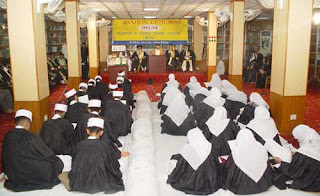
Awards Ceremony of The Institute of Classical Islamic Sciences (ICIS)


On the 2nd of June 2004 the award ceremony was held for the students of the Institute of Classical Islamic Sciences (ICIS). The ceremony was presided over by Professor Dr. Muhammad Tahir-ul-Qadri who is the Pro-Chancellor of the Minhaj University. There were many senior guests from the Minhaj University and central secretariat of Minhaj-ul-Quran International (MQI)

The seating arrangements were such that the male teachers were seated on the right side of Dr. Tahir-ul-Qadri and the female teachers along with the main female guests seated on the left side. The students of ICIS were seated on the floor directly in front of Dr. Tahir-ul-Qadri, partitioning the male from the female was a row of Egyptian cushions. Behind the students were seated the family members, guests and relatives of the students.

The male students were wearing the traditional Rumi hats and long white Arabian robes called the 'Jubbah'. The female students were wearing white scarves and long white Arabian robes for women called the 'Jilbaab'.

The ceremony began with the recitation of the Holy Qur'an by Qari Naveed, teacher ICIS. Following that was the singing of the famous Qasida Burdah of Imam Busiri by Zain Shabir from UK and Assad Siddique from France.

Dr. Tahir-ul-Qadri then began by reciting the Hadiths in Arabic and the students repeating after him, this was the beginning of the 'Ijazah's' giving by Dr.Tahir-ul-Qadri to the students of ICIS. In Total there were seven Ijazah's given, they are as follows;

  1. Al-Ijazah al-Ilmiyyah al-Aamah Fee asaaneed, Al-Dr Tahir-ul-Qadri.
    - Permission for general knowledge with chain of narrators of Dr.Tahir-ul-Qadri
  2. Asnadi Fee Uloom Al-Tassawuf Al-Tareeqah ilaa Sayyidnaa al-Ghowsal Azam Abi Muhammad Muhiyudeen al-Shaykh Abdul Qadir Jilaani.
    - Narrations in the science of Islamic Spiritualism, the Tareeqah or way of Shaykh Abdul Qadir Jilaani.
  3. Al-Ijazah bil isnaad al-Muttasil ilaa al imam al-Azam Abi Hanifah al-Nauman bin Thabit.
    - The permission with the continuous chain of narrators up to Imam Abu Hanifah
  4. Al-Ijaza bil isnaad al-Mutasil lil Jamiah al-sahih ila al-imam al-Bukhari
    - The Permission with the continuous chain of narrators from Sahih Bukhari by Imam Bukhari
  5. Al-Ijazah bil isnaad al-Mutasil lil jamiah ilaa al-imam Muslim al-Qusheri
    - The Permission with the continuous chain of narrators from Sahih Muslim by Imam Muslim.
  6. Al-Ijazah bil Isnaad al-Mutasil lish-Shifa bi tasreef Haqooq al-Mustafaa ilaa al-imam Abi al-Fazal al-Qadi Ayaad
    - The permission with the continuous chain of narrators from Ash-Shifa on the rights of Holy Prophet (saw) by Imam Qadi Ayaad.
  7. Ash-Shahadah Fee al-Daraasaat al-Islamiyyah.
    - Certificate in Isld a hadith Point to note is that Dr.Tahir-ul-Qadri narrateich has the shortest number of chains of narrators and Dr.Tahir-ul-Qadri is the only person in the world today to have this shortest link to the Holy Prophet (saw). This Hadith from Sahih Bukhari consists only of 13 narrators between Dr. Tahir-ul-Qadri and the Holy Prophet (saw) and now it is narrated by Dr.Tahir-ul-Qadri to the students of ICIS making their link to the Holy Prophet(saw) very close through the narration of this Hadith.

    After the recitation and repetition of the hadiths and Chain of narrators Dr.Tahir-ul-Qadri explained in detail about the Ijaza's given and also regarding one of the Hadith narrated by Imam Abu Hanifa down to Dr Tahir-ul-Qadri with every single narrator in the chain amazingly belonging to the Hanafi school of thought.

    The certificates were then presented to each student by Dr Tahir-ul-Qadri himself. There were two different certificates given, one was the Intermediate level and the other being advance level. The intermediate level certificate was given to the section A students of ICIS and the advance level certificate was given to the section B students of the ICIS. Medals were also presented for the highest marks achieved amongst the section A students.

    A Shield was presented to Dr. Tahir-ul-Qadri on behalf of ICIS for the appreciation of hard work and valuable time taken out from his extremely tight schedule. A shield was also given to Mian Mumtaz Ahmed on behalf of ICIS for his day and night endless hard work in the coordination and arrangements of ICIS. Finally to end the ceremony, farewell wishes and prayers for success in the future were given to the students of ICIS by Dr.Tahir-ul-Qadri.

    amic knowledge.